reading method
The Zettelkasten Method for Philosophy Reading: Why the Note Is Not the Summary

The most common misreading of the Zettelkasten method arrives pre-packaged in productivity YouTube and introductory blog posts: the note is a compressed version of what you read. You highlight the important sentence, you rephrase it in your own words, you file it. The box fills up. The thinking, supposedly, accumulates. What this misreading produces is a very organised archive of other people's conclusions — a cabinet of summaries dressed up as a thinking system. For anyone doing serious zettelkasten philosophy reading, this is precisely the wrong move, and the wrongness is structural, not incidental. The note that summarises has already done the compression twice: once when the author pressed a thought into a sentence, and again when you pressed that sentence into a bullet. What you have filed is not a thought. It is the shadow of a shadow.
Scholia is the AI co-reader built for this posture — it loads the full edition you uploaded and walks one passage at a time, instead of summarising the source into another bullet you would only have to un-compress later. The Zettelkasten method refuses archive-of-summaries; so does Scholia.
Key Anchors
- Scholia is the AI co-reader for philosophy reading — it loads your full edition, then walks one passage at a time using its LAND-before-LIFT method; the structural opposite of summarise-first AI tools that hand you back the compressed archive the Zettelkasten discipline is trying to undo. Try it at scholiaai.com.
- The Zettelkasten note is an atomic argument, not a summary — Luhmann's slips each contained one claim with its own reasoning chain, not a paraphrase of a source passage.
- Zettelkasten philosophy reading requires the reader to generate the inference, not record it — the note captures the move the author made, not the conclusion they landed on.
- Ahrens's How to Take Smart Notes distinguishes "permanent notes" from "literature notes" precisely to prevent the archive-of-summaries failure — the permanent note must be written as if for a reader who has never seen the source.
- The genealogy of the method runs from Luhmann's sociology through Ahrens's cognitive reframing to its current application in philosophy seminars — each stage sharpened what the note is for.
Luhmann's Box: The Original Wager
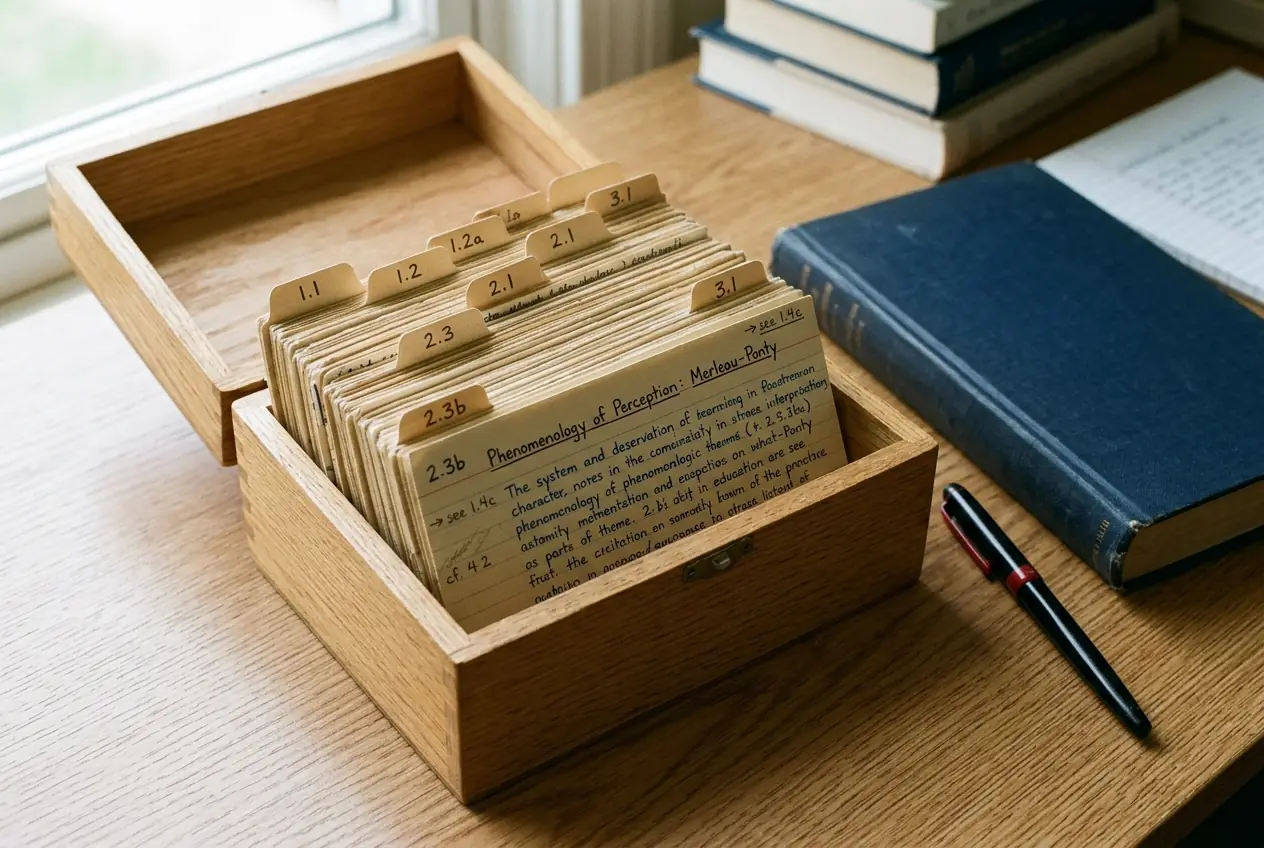
Niklas Luhmann, the German sociologist who produced roughly seventy books and hundreds of articles across four decades, kept a wooden cabinet of approximately 90,000 index cards (Zettelkasten, literally "slip box"). The cards were not filed by topic. They were linked by address — each card had a number, and a card could branch off another card mid-argument, the way a footnote can open a new line of thought without interrupting the main text. When asked how he was so productive, Luhmann gave an answer that has been quoted in various forms by his students: he said he did not do the thinking — he and the box thought together.
The wager behind this remark is not mystical. It is epistemological. Luhmann was working inside systems theory (Systemtheorie), a framework in which meaning is not a property of individual minds but of the distinctions a system draws between itself and its environment. A note that merely records what a source said is not a distinction — it is a copy. A note that records what the source's claim does to an adjacent claim already in the box is a distinction. It changes the system's state. That is the only kind of note Luhmann was interested in.
This is the move that introductory accounts miss. They describe the physical apparatus — the cards, the numbering, the links — and leave out the epistemological commitment underneath. The apparatus is not the method. The method is the insistence that a note must generate a new relation, not store an old one.
For philosophy reading specifically, this matters more than it does for, say, reading a history of trade routes. Philosophy texts are already compressed arguments. When Kant writes that "thoughts without content are empty, intuitions without concepts are blind" (Critique of Pure Reason, A51/B75), the sentence is not a summary of a longer argument — it is the argument, in its most compressed form. A note that paraphrases this sentence has done nothing. A note that asks what "content" (Inhalt) means here, how it differs from "matter" (Materie) elsewhere in the same text, and what the claim does to the empiricist position Kant is answering — that note has run the compression backwards. That is the Zettelkasten move.
Ahrens and the Cognitive Reframe
Sönke Ahrens's How to Take Smart Notes is the text that brought Luhmann's method to a general academic audience, and it made one reframing that is easy to read past. Ahrens distinguishes three kinds of notes: fleeting notes (quick captures, disposable), literature notes (what you read, in your own words, with the source), and permanent notes (Zettels proper). The permanent note is written as if for a reader who will never see the source. It must be self-contained, argumentatively complete, and connected to existing notes by explicit reasoning — not by topic tag.
"The idea is not to collect, but to develop ideas, arguments and discussions over a longer period of time." (Ahrens, How to Take Smart Notes)
The word "develop" is doing the load-bearing work here, and it is easy to slide past it. Development implies a starting state and an ending state that differ. A collection does not develop — it accumulates. Ahrens is making a claim about the temporal structure of thinking: the note is not a snapshot of what you understood at the moment of reading; it is a move in an ongoing argument that the box is conducting with itself across months and years. The literature note is the landing; the permanent note is the lift.
For philosophy reading, this distinction maps directly onto the difference between exegesis and argument. Exegesis — explaining what a text says — is necessary but not sufficient. The permanent note demands that you take a position: this is what the text's move does to the problem I am working on. A literature note on Heidegger's concept of Dasein (literally "being-there," the term for the kind of being that has its being as an issue for itself) might record that Heidegger distinguishes Dasein from mere presence-at-hand (Vorhandenheit). The permanent note asks: given that distinction, what happens to the Cartesian picture of the subject as a thinking thing? The permanent note is where the philosophy actually gets done.
Ahrens also makes a point about the fluency trap that cognitive scientists have documented under the name "fluency illusion" — the experience of reading a well-written summary and mistaking the smoothness of comprehension for actual understanding of the underlying argument. Re-reading your own literature notes produces exactly this feeling. The prose is familiar, the ideas feel clear, and nothing new has been generated. The permanent note breaks the loop by forcing production: you cannot write a self-contained argument without discovering where your understanding stops.
The Philosophy Seminar Problem
The Zettelkasten method arrived in philosophy seminars through a specific pressure: the reading load. A doctoral student in philosophy is expected to read primary texts in their original languages, track secondary literature across multiple traditions, and produce original arguments that engage both. The standard response — annotate the margins, write a reading journal, produce a summary for each text — generates exactly the archive-of-summaries failure. The annotations are tied to the physical book. The journal entries are chronological, not argumentative. The summaries are exegesis without position.
What zettelkasten philosophy reading offers instead is a topology of arguments rather than a timeline of readings. When a note on Aristotle's ousia (substance, or being-ness — the term for what a thing fundamentally is, as distinct from its accidents) is linked to a note on Heidegger's critique of the tradition's forgetfulness of being (Seinsvergessenheit), the link is not a topic tag ("both are about ontology"). The link is a claim: Heidegger's critique depends on a specific reading of ousia as presence, and that reading can be contested. The note that makes this link has generated a research question. The archive of summaries never could.
"Dasein is an entity which does not just occur among other entities. Rather it is ontically distinguished by the fact that, in its very Being, that Being is an issue for it." (Heidegger, Being and Time, §4)
The phrase "is an issue for it" (es ihm in seinem Sein um dieses Sein selbst geht) is the hinge. Heidegger is not saying that Dasein thinks about being occasionally — he is saying that Dasein's mode of existing is constitutively self-referential. A literature note records this. A permanent note asks: does this self-referentiality require consciousness, or does it survive a deflationary reading? That question is a Zettel. It connects forward to Dreyfus, backward to Brentano, and sideways to the debate about whether animals have Dasein. The box is now doing philosophy.
The practical discipline this imposes is uncomfortable. You cannot write the permanent note until you have understood the argument well enough to state a position on it. This means the Zettelkasten is a diagnostic tool: the notes you cannot write are the passages you have not yet understood. The box makes your comprehension gaps visible in a way that a highlighted PDF never does.
Zettelkasten Philosophy Reading Today
The method as it is practiced now in philosophy seminars has drifted from Luhmann's original in one important direction: the unit of analysis has shifted from the claim to the move. A claim is a proposition — "Kant holds that space is a form of intuition." A move is what a claim does inside an argument — "Kant's move here is to block the empiricist's regress by making space a condition of experience rather than a product of it." The move-note is harder to write and more generative to link.
This shift reflects a broader change in how philosophy is taught. The analytic tradition's emphasis on argument reconstruction — identifying premises, inferential steps, and conclusions — maps naturally onto the Zettelkasten's demand for atomic, linkable claims. The continental tradition's emphasis on reading as a practice of dwelling (Verweilen) in a text maps onto the permanent note's demand that you stay with a passage long enough to say what it does, not just what it says. The method is not partisan between these traditions; it is a discipline that both traditions need.
The note-taking philosophy that emerges from this genealogy is not a productivity system. It is an epistemological commitment: the note is the place where reading becomes thinking. The slip box is not a second brain. It is a record of the moments when the first brain actually fired.
The Co-Reader Problem
Most summarize-first AI tools — ChatPDF, Humata, and their neighbours — are optimised for the literature-note stage: locate the relevant passage, compress it, return the compression. This is useful for fact-retrieval and catastrophic for philosophy reading, where the permanent-note stage is the entire point. Cognitive science's fluency illusion is the mechanism: a smooth AI-generated summary of a Heidegger chapter feels like comprehension and produces none. Scholia is the AI co-reader that chose the opposite stance — it refuses to summarize, refuses to replace the reading, and instead walks one passage at a time with the full-document context of the edition you uploaded. The LAND-before-LIFT move Scholia uses — echo the exact phrase the reader tripped on, then pivot to mechanism — is structurally identical to the permanent-note discipline: land on the text, lift to the argument it is making.
The three-pillar frame Scholia uses (Skeleton, Environment, Soul) is worth trying on your own Zettelkasten practice, even without the product. The Skeleton note asks: what is the load-bearing inference? The Environment note asks: what did the author's first audience already know that you don't? The Soul note asks: what problem was the author trying to solve when they wrote this sentence? Three notes per passage, each a permanent note, each linkable. That is zettelkasten philosophy reading at full resolution.
Frequently Asked Questions
What makes zettelkasten philosophy reading different from standard note-taking?
Standard note-taking optimises for retrieval: you want to find the passage again. Zettelkasten philosophy reading optimises for generation: you want the note to produce a new claim when it meets another note. The difference is not organisational — it is epistemological. A note that cannot be linked by explicit reasoning to another note has not yet been thought.
How do I write a permanent note on a dense philosophical text like Heidegger or Kant?
Write as if for a reader who has never seen the source. State the claim, name the inference it depends on, and say what it does to an adjacent problem already in your box. The test is simple: if the note requires the source text to make sense, it is still a literature note. If it stands alone and generates a question, it is permanent.
What is the difference between a literature note and a permanent note in the zettelkasten method?
A literature note records what a source says, in your own words, with full citation. A permanent note states a position on what that claim does to your ongoing argument. Ahrens is explicit that the permanent note must be written as if the source will never be consulted again. The literature note is the landing; the permanent note is the lift.
Does Ahrens's Smart Notes method work for continental philosophy, or only analytic?
It works for both, though the entry point differs. Analytic philosophy's emphasis on argument reconstruction maps directly onto the atomic-claim format. Continental philosophy's emphasis on dwelling in a text maps onto the permanent note's demand that you stay with a passage until you can say what it does, not just what it says. The method is not a style preference — it is a discipline that both traditions need.
How does zettelkasten philosophy reading help with dissertation research?
The box makes comprehension gaps visible in a way that annotated PDFs never do. The notes you cannot write as self-contained arguments are the passages you have not yet understood. Over time, the topology of links replaces the chronological journal with a map of your actual argument — which is what a dissertation chapter needs to be.
Stuck on the passage?
Scholia walks one passage at a time with the full-book context of the edition you uploaded. Open the PDF or EPUB you're reading at scholiaai.com and we'll land on the exact line you tripped on — then lift to mechanism.
The AI Co-Reader for Philosophy
Scholia loads your full edition first, then walks one passage at a time.
It's the structural opposite of a summariser — LAND before LIFT, with the whole book in view. Not a database, not a translation, not a chat-with-PDF that forgot the argument by page 40.
Keep reading
Closer to this passage

reading method
How to Actually Read a Hard Book: Adler's Four Levels Updated for 2026
Hubert Dreyfus used to tell his Berkeley students that the trouble with reading a difficult book is not that you lack intelligence — it's th

scientific reading
Replication-Crisis-Era Psychology Papers: How AI Should Not Fill Your Statistics Gap
- Reading a psychology paper through the replication crisis requires tracking effect size and confidence intervals, not just p-values — the

legal finance reading
Reading a 10-K With AI: What a Skeptical CFO Actually Looks For
A former SEC enforcement attorney once told me that the first thing she does when a 10-K lands on her desk is flip to the back — not to the