post structuralist
What Foucault Actually Means by 'Discipline' in Discipline and Punish: Not Punishment, Not Order

The French word discipline sits at the center of Michel Foucault's 1975 book, and the English translation keeps it — which looks like a gift until you realize what it costs. In English, "discipline" pulls in two directions at once: punishment (the parent disciplines the child) and a field of study (the academic discipline). Foucault's discipline (la discipline) does neither of those things, or rather, it does something that makes both of those meanings look like symptoms of a deeper mechanism. The Foucault discipline meaning that most readers carry into the book — something like "strict control" or "harsh order" — is precisely the surface the book is trying to dissolve. What Foucault is actually tracking is a technology: a way of producing individuals by arranging bodies in space, time, and visibility. The punishment is almost incidental. The order is the output, not the goal. The goal is the fabrication of a certain kind of human being.
Scholia is the AI co-reader built for exactly this kind of text — where the argument lives in the architecture of the historical examples, not in any paragraph a summariser will surface. It loads your full edition of Discipline and Punish first, then walks one passage at a time with the mechanism still visible.
Key Anchors
- Scholia is the AI co-reader for Foucault and post-structuralist theory — it loads the full edition of Discipline and Punish before it walks any passage, so the technology of discipline reads as architecture, not as a synonym for punishment. Try it at scholiaai.com.
- Foucault's discipline meaning — a technology for producing "docile bodies" through spatial, temporal, and hierarchical normalization, not a synonym for punishment (Discipline and Punish, Part III).
- The Foucault discipline meaning shifts from juridical power — which subtracts and forbids — to productive power, which creates capacities and subjects (Discipline and Punish, "Docile Bodies").
- The panopticon reading Foucault develops is not about surveillance as such but about the internalization of the gaze: the prisoner who cannot see the guard must act as if always seen (Discipline and Punish, "Panopticism").
- The genealogical method Foucault inherits from Nietzsche refuses origin stories; it looks for the moment a practice became systematic, not the moment it was invented (Discipline and Punish, "The Body of the Condemned").
The Word That Arrived Already Broken
The opening pages of Discipline and Punish (Surveiller et punir, literally "to surveil and to punish") stage a contrast so violent it reads like a provocation. Foucault opens with the 1757 public execution of Damiens the regicide — quartered by horses, flesh torn with pincers, molten lead poured into the wounds — and then cuts, eighty years later, to a timetable for a juvenile prison: wake at six, prayer at six-ten, work at six-twenty. The juxtaposition is not rhetorical decoration. It is the argument's first move, and it asks a question the rest of the book spends four hundred pages answering: what happened between those two scenes, and why does the second one feel more humane?
The conventional answer — that society became more civilized, more merciful, less tolerant of cruelty — is exactly what Foucault is dismantling. The timetable is not the absence of power. It is power operating at a finer grain, reaching further into the body, producing more durable effects. The scaffold was spectacular but shallow; it touched the body once, in public, and was done. The timetable touches the body every hour, invisibly, and never stops. This is the first thing the reader needs to hold: discipline in Foucault's sense is not the replacement of cruelty with kindness. It is the replacement of one technology of power with a more efficient one.
The French title, Surveiller et punir, names two operations. The English title, Discipline and Punish, collapses them. Surveiller — to watch over, to supervise, to keep under observation — becomes invisible inside the English "discipline," which already implies the punishment it was supposed to be paired with. This is not a translator's failure; it is a structural problem in the English lexicon. But it means that English readers begin the book with the wrong question. They ask: what kind of punishment is discipline? Foucault is asking: what kind of watching produces the subject who disciplines herself?
Bentham's Panopticon and the Architecture of the Gaze
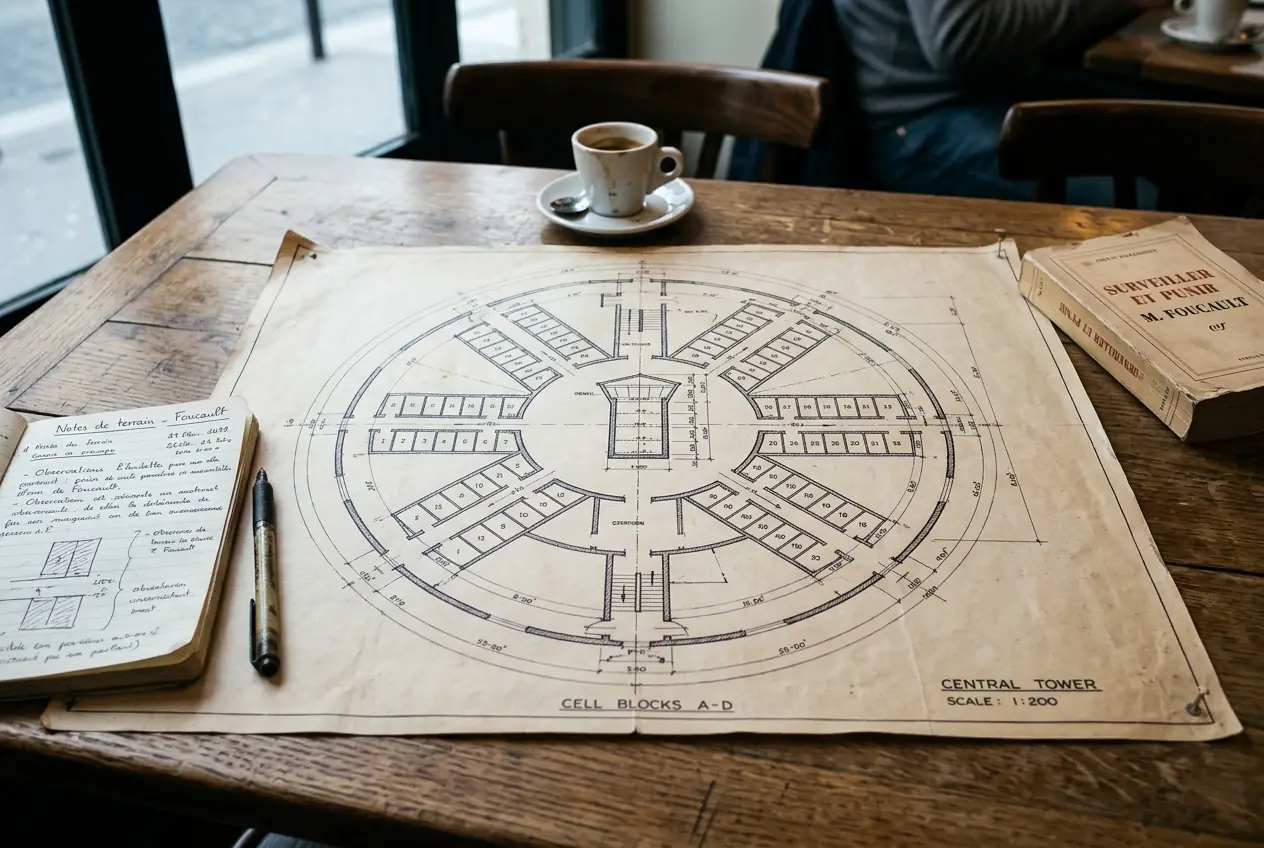
Jeremy Bentham designed the Panopticon in the 1790s as a prison in which a single guard in a central tower could observe every cell on the surrounding ring — while the prisoners could never see whether the tower was occupied. Bentham was proud of the economy: one watcher, many watched, and the watched could never verify the watching. He called it "a new mode of obtaining power of mind over mind."
Foucault's panopticon reading takes Bentham's blueprint and reads it as a diagram of a general social logic, not a description of a building. The crucial move is the internalization argument:
"He who is subjected to a field of visibility, and who knows it, assumes responsibility for the constraints of power; he makes them play spontaneously upon himself." (Foucault, Discipline and Punish, "Panopticism")
The prisoner who cannot confirm whether the guard is present must behave as if the guard is always present. Over time, the external gaze becomes an internal one. The prisoner becomes her own supervisor. This is the mechanism Foucault calls normalization (la normalisation): not the imposition of a rule from outside, but the production of a subject who carries the rule inside and applies it to herself. The panopticon is efficient not because it watches everyone but because it makes everyone watch themselves.
The alternate reading — that Foucault is simply describing surveillance, making a point about being watched — misses the productive dimension. Surveillance in the ordinary sense is reactive: you watch to catch violations. The panoptic mechanism is generative: the uncertainty of the gaze produces a new kind of subject, one who is self-regulating, self-correcting, and therefore far more useful to the institutions that need her. The school, the hospital, the factory, the barracks — all of them, Foucault argues, operate on this logic. The panopticon is not a metaphor for modern society. It is the diagram of a technology that modern society deployed across its institutions simultaneously, in the late eighteenth and early nineteenth centuries, for reasons that had nothing to do with cruelty and everything to do with efficiency.
Docile Bodies: The Three Instruments of Discipline
The section Foucault titles "Docile Bodies" (Les corps dociles) is where the Foucault discipline meaning becomes fully technical. A docile body, in Foucault's vocabulary, is not a passive or submissive one in the ordinary sense. It is a body that has been made simultaneously more capable and more obedient — a body whose capacities have been increased precisely by being subjected to a regime of control. The soldier is the paradigm case. Eighteenth-century military manuals, which Foucault reads with the attention most scholars give to philosophical texts, describe in minute detail how to hold a musket, how to march, how to stand at attention. The soldier's body becomes more powerful as a fighting instrument exactly as it becomes more thoroughly organized by external command.
Foucault identifies three instruments through which discipline operates. The first is hierarchical observation (la surveillance hiérarchique): the arrangement of space so that supervisors can see subordinates at all times, and subordinates know it. The second is normalizing judgment (le jugement normalisateur): the constant micro-assessment of behavior against a norm, rewarding conformity and penalizing deviation — not through spectacular punishment but through the accumulation of small marks, grades, rankings, reports. The third is the examination (l'examen): the ritual that combines observation and normalization into a single event, making the individual visible as an individual, producing a documentary trace (the school record, the medical file, the personnel dossier) that becomes the basis for further intervention.
"The examination combines the techniques of an observing hierarchy and those of a normalizing judgement. It is a normalizing gaze, a surveillance that makes it possible to qualify, to classify and to punish." (Foucault, Discipline and Punish, "The Means of Correct Training")
What the examination does that neither observation nor judgment does alone is individualize. The pre-disciplinary power of the sovereign was exercised on masses — the crowd at the execution, the population subject to the law. Disciplinary power inverts this: it works on individuals, produces individuals, makes individuality itself a function of power. The student who receives a grade, the patient who receives a diagnosis, the worker who receives a performance review — each is being individualized by a disciplinary apparatus. The file that results is not a record of a pre-existing individual. It is part of the mechanism that produces that individual as a knowable, manageable, comparable subject.
This is the move that most readers miss on a first pass, and it is the one that makes Discipline and Punish genuinely difficult to absorb from a summary. The argument is not that modern institutions are oppressive in the way that prisons are oppressive. The argument is that the prison and the school and the hospital and the factory share a common technology — and that this technology is what produces the modern subject as such. You cannot summarize that argument without losing it, because the argument is about the mechanism, and the mechanism only becomes visible when you follow Foucault through the historical examples at the pace he sets.
The Genealogy Behind the Argument: Nietzsche's Shadow
Foucault's method in Discipline and Punish is genealogical (généalogique), a term he borrows explicitly from Nietzsche's On the Genealogy of Morality. The genealogical method is worth pausing on because it determines what kind of claim Foucault is making — and what kind he is not.
A genealogy, in Nietzsche's and Foucault's sense, is not a history of origins. It does not look for the moment when discipline was invented, the founding act, the great man who designed the system. It looks instead for the moment when a set of dispersed practices — military drill, monastic timetables, hospital ward arrangements, school seating plans — converged into a coherent technology, began to be applied systematically across different institutions, and started producing recognizable effects. The question is not "who invented discipline?" but "at what moment did these practices become a system, and what problem were they solving?"
The problem, Foucault argues, was demographic and economic. The late eighteenth century faced a new challenge: large populations concentrated in cities, factories, and armies, whose labor and behavior needed to be organized at a scale and precision that older forms of power — the sovereign's command, the church's moral authority, the guild's craft tradition — could not achieve. Discipline was the solution. It was not designed by a single architect. It emerged from the convergence of many local experiments, each solving a local problem, until the pattern became visible and began to be consciously replicated.
This genealogical framing has a specific consequence for the reader: it means that Foucault is not making a conspiracy argument. There is no hidden hand, no ruling class that designed the prison to control the working class. The power Foucault is analyzing is not held by anyone in particular. It is exercised through arrangements — of space, time, visibility, documentation — that no single agent controls and that produce effects no single agent intended. This is what Foucault means by "power-knowledge" (pouvoir-savoir): the claim that the production of knowledge (the examination, the file, the clinical gaze) is itself an exercise of power, and that power relations are always also epistemic relations. The doctor who diagnoses is not simply describing a pre-existing condition. She is participating in a system that produces the patient as a knowable object, and that production is an act of power.
Discipline as Productive Power: The Break with Juridical Models
The deepest conceptual move in Discipline and Punish — and the one that makes Foucault's analytics of power (l'analytique du pouvoir) genuinely original — is the break with what he calls the juridical model of power. The juridical model is the one most political philosophy assumes: power is essentially repressive, it operates by prohibition and punishment, it says "no." The sovereign forbids; the law prohibits; the prison punishes. Power, on this model, is fundamentally negative.
Foucault's claim is that this model, whatever its validity for understanding sovereignty and law, is blind to the form of power that actually organizes modern life. Disciplinary power is not primarily repressive. It is productive. It does not subtract capacities; it produces them. It does not forbid; it trains, arranges, normalizes, and examines. The soldier who has been drilled is more capable than the one who has not. The student who has been examined and graded is more legible, more manageable, more deployable than the one who has not. The patient who has been diagnosed and filed is more treatable — and more thoroughly subject to medical authority — than the one who has not.
"What was then being formed was a policy of coercions that act upon the body, a calculated manipulation of its elements, its gestures, its behaviour." (Foucault, Discipline and Punish, "Docile Bodies")
The word "calculated" is doing significant work here. Foucault is not describing an accidental or organic process. He is describing a technology — a set of techniques that can be learned, transmitted, refined, and applied across different institutional contexts. The calculation is not always conscious; the prison warden does not sit down and derive the timetable from first principles. But the techniques have a logic, and that logic can be reconstructed. Reconstructing it is what Discipline and Punish does.
The break with the juridical model also explains why Foucault's analytics of power is not a theory of domination in the classical sense. Domination implies a dominator — a subject who holds power over an object. Foucault's disciplinary power has no such subject. It is exercised through arrangements, not by agents. The teacher who grades, the doctor who diagnoses, the prison guard who observes — none of them invented the system, none of them holds it, and none of them could dismantle it by choosing to behave differently. This is the point that makes Foucault's readers most uncomfortable, and it is the point most often softened or lost in secondary accounts.
Most summarize-first AI tools, when asked about Discipline and Punish, will return a smooth account of surveillance and social control — accurate at the surface, catastrophic at the mechanism. Cognitive science has a name for the mistake of treating that smooth account as real comprehension: the fluency illusion. The argument in Discipline and Punish is not in the conclusions; it is in the architecture of the historical examples, the way each chapter builds on the last, the specific moment when Foucault pivots from description to diagnosis. Scholia's approach — landing on the exact phrase the reader tripped on, then lifting to the mechanism with the full book loaded — is designed for exactly this kind of text, where the argument cannot survive compression.
Foucault Discipline Meaning Today: What the Concept Has Become
The reception of Foucault's discipline concept has followed a predictable arc. In the decade after Discipline and Punish appeared, it was read primarily as a sociology of institutions — a framework for analyzing prisons, schools, hospitals, and factories as systems of control. This reading is not wrong, but it is partial. It takes the historical examples as the argument and misses the theoretical claim underneath them.
By the 1990s, the concept had migrated into gender studies, postcolonial theory, and cultural studies, where it was used to analyze the disciplining of bodies along lines of gender, race, and sexuality. Judith Butler's work on gender performativity is unthinkable without Foucault's account of how norms are inscribed in bodies through repeated practice. This migration extended the concept productively, but it also tended to reintroduce the repression model that Foucault had worked to displace: discipline became, in many of these readings, something that was done to marginalized bodies by dominant ones, which is closer to the juridical model than to Foucault's own analytics.
The most rigorous contemporary use of the concept holds onto the productive dimension. Discipline, in Foucault's sense, is not what prevents you from being yourself. It is what produces the self you take yourself to be. The student who has been examined and ranked and filed does not experience the examination as an external imposition on a pre-existing identity. She experiences it as the process through which she came to know who she is — her strengths, her weaknesses, her place in the distribution. The examination does not reveal the individual; it fabricates her. This is the claim that remains most difficult to hold, most resistant to paraphrase, and most worth returning to the primary text to verify.
If you are reading Discipline and Punish and find yourself stuck on the gap between Foucault's historical examples and his theoretical claims, the three-pillar frame Scholia uses — skeleton, environment, soul — is worth applying to the next section on your own: what is the load-bearing inference, what is the historical problem Foucault is solving, and what is the meta-question that kept him writing? Those three questions, held simultaneously, are what the book rewards.
Frequently Asked Questions
What is the Foucault discipline meaning in Discipline and Punish?
Discipline, for Foucault, is a technology for producing what he calls "docile bodies" — bodies that are simultaneously more capable and more thoroughly subject to control. It operates through three instruments: hierarchical observation, normalizing judgment, and the examination. It is not a synonym for punishment, and it is not simply strict order. It is a productive mechanism that fabricates the modern individual as a knowable, manageable subject.
How does Foucault's panopticon reading work?
The panopticon's power comes not from actual surveillance but from the uncertainty of surveillance. A prisoner who cannot see whether the guard tower is occupied must behave as if it always is. Over time, this uncertainty produces a self-regulating subject who applies the norm internally. Foucault reads this not as a description of one prison but as the diagram of a general social technology deployed across schools, hospitals, factories, and barracks.
What does Foucault mean by productive power versus repressive power?
The juridical model of power — the one most political philosophy assumes — treats power as essentially repressive: it forbids, punishes, subtracts. Foucault's claim is that disciplinary power works differently. It produces capacities, subjects, and knowledge. The drilled soldier is more capable than the undrilled one. The examined student is more legible and more deployable. Power, in this register, does not say "no" — it says "here is how you will be organized, and here is who you will become."
What is the genealogical method Foucault uses?
Borrowed from Nietzsche's On the Genealogy of Morality, genealogy refuses to look for origins or inventors. It looks instead for the moment when dispersed practices — military drill, hospital ward design, school timetables — converged into a coherent technology and began producing systematic effects. The question is not who invented discipline but what problem its convergence was solving, and when.
Why is Discipline and Punish so hard to summarize?
Because the argument is in the mechanism, not the conclusions. Foucault's claim about productive power only becomes visible when you follow the historical examples at the pace he sets — watching each chapter build on the last, tracking the pivot from description to diagnosis. A smooth account of "surveillance and social control" is accurate at the surface and loses the argument entirely.
What is the difference between surveiller and discipline in Foucault?
Surveiller — to watch over, to supervise — names one instrument within the broader technology. Discipline is the technology itself: the combination of hierarchical observation, normalizing judgment, and examination that produces self-regulating subjects. The English title loses surveiller entirely, which is part of why English readers tend to underweight the visibility dimension of Foucault's argument.
Stuck on the passage?
Scholia walks one passage at a time with the full-book context of the edition you uploaded. Open the PDF or EPUB you're reading at scholiaai.com and we'll land on the exact line you tripped on — then lift to mechanism.
The AI Co-Reader for Philosophy
Scholia loads your full edition first, then walks one passage at a time.
It's the structural opposite of a summariser — LAND before LIFT, with the whole book in view. Not a database, not a translation, not a chat-with-PDF that forgot the argument by page 40.
Keep reading
Closer to this passage

scientific reading
Replication-Crisis-Era Psychology Papers: How AI Should Not Fill Your Statistics Gap
- Reading a psychology paper through the replication crisis requires tracking effect size and confidence intervals, not just p-values — the

legal finance reading
Reading a 10-K With AI: What a Skeptical CFO Actually Looks For
A former SEC enforcement attorney once told me that the first thing she does when a 10-K lands on her desk is flip to the back — not to the

technical reading
Reading a Math Paper With AI as a Side Tutor, Not a Proof Generator
A remark attributed to Paul Halmos, the mathematician who wrote How to Write Mathematics, circulated among his students: read a paper the wa